
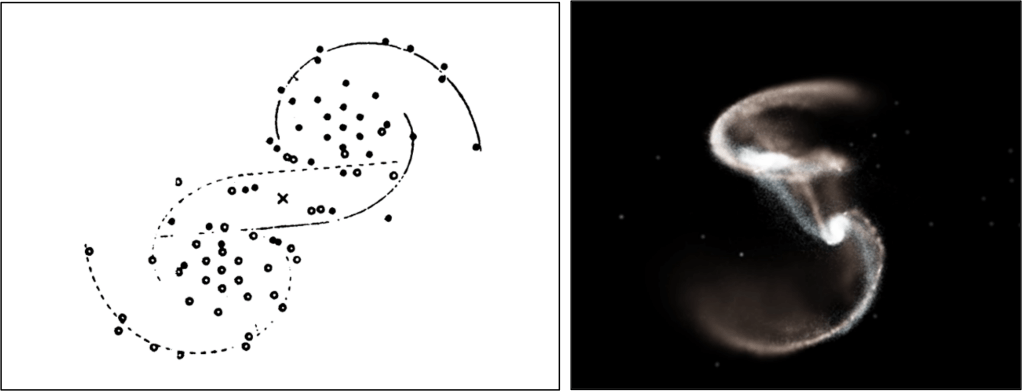
Simulations of interacting galaxies, from Holmberg’s experiment in 1941 (left) to modern cosmological simulations (right). Through his simulation, Holmberg was able to reproduce the formation of spiral arms in galaxies.
The Rose Center of Earth and Space at the American Museum of Natural History is a familiar place to me. My dad would always bring me there as a kid, so visiting that exhibit—with the spiral stairs that follow the 13-billion-year history of the Universe, the light-up panels that illuminate the nature of galaxies, and finally the spectacular Hayden sphere—was almost like returning to a playground. In my ten-year-old mind, all of this was a bright mystery with glass walls and interactive buttons to go with pictures of the night sky. Now, as a young, aspiring astrophysicist, the Rose Center still holds a lot of mysteries.
One particular panel strikes me more than the rest: Interacting Galaxies. The panel shows an animation of galaxies colliding. In the video, the spiral arms of the galaxies entwine and scatter as they pass close to each other. Galaxies are magnificent, dynamic structures. When they collide, their mutual gravity causes them to twist and distort. In other words, they are “tidally disrupted.”
I never remembered this video of colliding galaxies as a kid. Now, ten years later, I have seen the same animation a countless number of times in my research and classes. The visualization was created using a computer simulation, an extremely powerful tool that can broadly model any system of particles under the influence of physical forces. In this case, the collision was simulated as the force of gravity on particles of stars, gas, and dust in the galaxies.
The most intriguing part of the panel on interacting galaxies was not this animation, however—it was a little blurb titled: “A Tabletop Galaxy Collision.” In 1941, the Swedish astronomer Erik Holmberg performed the first simulation of interacting galaxies, well before the age of modern computers. How did he do it?
To simulate an interacting system of stars, Holmberg constructed two artificial galaxies on a workbench using 37 light bulbs. The brightness of each light bulb was proportional to its mass. With an array of light bulbs to model the mass distribution of the galaxies, Holmberg could visualize the gravitational attraction from a given point source. For every step of the “simulation,” Holmberg moved each light bulb to follow the motion of mass within each galaxy. In this way, the orbits of the stars could be traced out during the encounter between the two galaxies.
The beautiful outcome of Holmberg’s experiment is that the model galaxies were distorted through the simulation—spiral arms were even created. Holmberg showed that gravitational interactions can disrupt the structure of galaxies and are a mechanism behind the formation of spiral galaxies. He published his results in a paper, “On the Clustering Tendencies among the Nebulae. II. a Study of Encounters Between Laboratory Models of Stellar Systems by a New Integration Procedure.”
Apart from illustrating a key phenomenon in galaxy evolution, Holmberg made a significant step toward modern astronomy. Today’s simulations have expanded to include more physics. In addition to ordinary matter like stars and gas, these simulations can model dark matter and dark energy in an expanding space time—in this way, they are more cosmological. Instead of performing tedious calculations for individual particles, supercomputers take advantage of more efficient numerical techniques.
Ultimately, Holmberg’s study was an early demonstration of how problems in astrophysics can be approached with computation and inventiveness. As a researcher, I am passionate about simulatingic the Universe. Cosmological simulations are an active field of study, with a lot of opportunities for furthering our understanding of galaxies and the Universe as a whole. It was exciting to see that the concept of galaxy simulations had been there all along—not just back to 1941, the time of lightbulbs and tabletops, but also to the museum I visited as a ten-year-old kid.
Sources and Further Reading
Holmberg, Erik. “On the Clustering Tendencies among the Nebulae. II. a Study of Encounters Between Laboratory Models of Stellar Systems by a New Integration Procedure.” The Astrophysical Journal, 94:385-395, November 1941.
Vogelsberger, Mark and Marinacci, Federico and Torrey, Paul and Puchwein, Ewald. “Cosmological Simulations of Galaxy Formation.” Nature, December 2019.
 Shalini Kurinchi-Vendhan