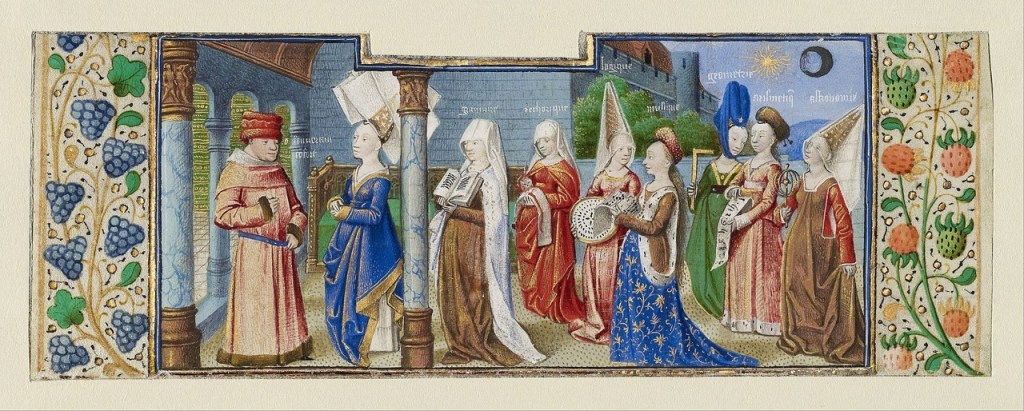
Philosophy Presenting the Seven Liberal Arts to Boethius (1460–1470). The J. Paul Getty Museum, Los Angeles.
When the Roman philosopher Boethius was depressed about his place in the Universe, he turned to a cosmic vision. In this vision, he imagines a conversation with eight fashionable ladies, each a liberal art, captured in miniature gold-leafed painting from the 15th century. Despite being so small, the image is flushed with the colors and personalities each woman. Philosophie heads the line, Grammaire reads her book, the virtuous Rhétorique has her eyes fixed on the ground, the stern Logique faces the cheerful Musique, and Géométrie holds her ruler while talking to Arithmétique. The woman who strikes me most, however, is Astronomie.
Maybe this has to do with being a young, wishful female astrophysicist myself. But the way Astronomie hangs behind the rest of the women, alone and dreamily looking up at the sky with her mouth slightly open, touches me. That is me: walking ten steps behind with my head in outer space. How else could I relate to this woman in a medieval painting? She’s obviously a scientist, holding her tiny model of the Universe. Like the other women, she has style: with her golden, sand-colored dress, her bright red jacket. She has a veil falling from her noble “princess hat”—the veil falls, and just covers her eyes. This small detail, the veil, stops me as I start thinking about Astronomie the woman. Her purpose is to envision the heavens, to see past the boundaries of our planet, our galaxy. Then why must her eyes be covered?
Throughout history, there has been the premodern concept of the “veiled” woman: she lives in her own sphere, separate from a prevailing masculine order. The veil metaphorically possessed every woman and girl—including, in this painting, Astronomie. It strikes a similarly chilling tone to the “mystique” described in Betty Friedan’s social chronicle of second-wave feminism, four centuries later. But as an unrealized astronomer standing before an old painting, decades after The Feminine Mystique, the Astronomie’s veil is troubling. Yet her feminine mystique could also give rise to the woman astronomer’s incredible awe for the unknown. It is a trait that belongs to any person who deeply loves her vocation.
Perhaps the most extreme example of a veiled woman was the medieval anchoress. Secluding herself from society in a cell attached to a church, she led a life of intense prayer and spiritual exploration. Solitary: maybe. Physically hidden from the world: yes. Nevertheless, she was profoundly connected to the heavens. Medieval female mystics such as Julian of Norwich, and Hildegard von Bingen before her, were like astronomers in this respect—at once enclosed and expanded by a divine relationship that was cosmic.
Almost nothing is known about Julian of Norwich, except that she created one of the earliest novels written by a woman, titled The Revelations of Divine Love from the 14th century. Julian invented the phrase, “all shall be well,” that survives in consolations today, and above all she documents her sixteen visions from the universe. She is most like an astronomer in her iconic hazelnut revelation, in which she sees the birth of the world: “something small, no bigger than a hazelnut, lying in the palm of my hand.” The small ball in Julian’s hand is resembles Astronomie’s little armillary sphere, a device used to model celestial coordinates. Julian and Astronomie each hold their respective ‘hazelnuts’ as they look above for an explanation, which is: “It is everything which is made.” The 12th century polymath Hildegard of Bingen also imagined that the universe began as a small sphere: not exactly a hazelnut, but a “cosmic egg” that burst into fire, water, and earth—the “whole of the world” in a big bang. Hildegard was also a medieval female mystic and somewhat an astronomer, too. In a self-portrait, she shows herself at work in a narrow chapel room reminiscent of the inside of the telescope dome. Like monasteries, observatories are solitary places. Hildegard looks like an astronomer, overwhelmed by what she sees above.
In a fanfiction-esque poem about Julian, the humanist writer Denise Levertov reanimates hazelnuts and eggs as a feminine symbol because of their spherical shape, with the potential to contain new life. The celestial orb in Astronomie’s can also be interpreted as being feminine too—but what are the consequences of these women being so distinctly women? The real Julian did not hesitate to call herself vulnerable, as she claims in her book: “I am a woman, ignorant, weak and frail.” Once again, we recall the picture of Astronomie gazing up toward the heavens; but this time, notice that her eyes are directly looking toward the fiery, masculine symbol of the Sun, while the feminine, shadowed crescent Moon just misses her line-of-sight. In a way, Astronomie is positioned as a woman veiled by her ignorance of the cosmos, dependent on the light of a remote, all-powerful male (God, to Julian and Hildegard). So then: is the woman astronomer really limited by her femininity?
Here is the perfect moment make a return to Betty Friedan, to understand the veil. Her words resonate for the painted character, the medieval mystic, and women astronomers today:
The feminine mystique says that the highest and the only commitment for women is the fulfillment of their own femininity. It says that the great mistake of Western culture, through most of its history, has been the undervaluation of this femininity…
The Feminine Mystique
so long as the definition of femininity and fulfillment for women is not bounded. In a Scientific American article about the rising culture of women in astronomy, Ann Finkbeiner wonders whether women astronomers should just be called “astronomers” —but in fact, “women astronomers” is an outspoken, proud title for them.
I do not think the women astronomer is limited by her femininity, at least I cannot accept it completely. The idea of illumination and wholeness verges on a common trait of astronomers that is ultimately empowering, while being self-effacing. It demonstrates a humbling capacity for enlargement, and an immense wonder for nothingness. That Julian sees herself in the hazelnut, which is both small and the “whole of world” at the same time, is not unlike the way astronomers revel in the small role they play in the grandeur of the cosmos. The female visionary’s ability to embrace her insignificance in the expanse of the unknown is not just in spite of her femininity, but because of it. Though she is veiled, Astronomie’s soul has this incredible, humble capacity to be expanded by what little glimpses she gets of the cosmos through her veil. She sees something worth holding in her tiny model of the Universe: which is “nothing” when compared to actual complexities of the Universe, but also her whole world, all at once. Like this tiny Universe, she is full of enclosed potential and packed with contemplation—her gaze is full of wonder.
The female astronomer’s ability to embrace her insignificance in the huge expanse of the unknown is not just in spite of her femininity, but because of it. After spending more time with this painting, I cannot believe the veil only means suppression. Astronomie should be given credit for the way she’s different from Rhétorique, whose eyes are fixed on the ground. Even Philosophie, whose bold gaze looks straight ahead, is just looking at Boethius. Astronomie, on the other hand, is untethered by the Earth or the people around her. Out of all these women, she alone hitches up her skirt in order to better look to the heavens, maybe like a princess, maybe like a brave woman who rejects the norm set by the other six women in the painting. The female visionary was once, and was still, part of the earthly world; nevertheless, she strives to understand the heavens, and she inextricably ties herself to it.
The women that have come before me have always embodied the attitude and emotions of aspiring astronomers. We have all worn the same, white-laced veil to some extent. They knew that their place and time on earth was insignificant in the grand scheme, just as astronomers use this truth as motivation to explore the cosmos. We do not study the Universe because it is clear to us, but because it is hidden and veiled from us. These female astronomers—or mystics, or poets, or women as a whole—can take that, and turn their veil into a telescope for inspiration. And so, I would like to believe that Astronomie wears the veil because she loves the mystery and wonder that come from it.
Sources and Further Reading
Philosophy Presenting the Seven Liberal Arts to Boethius, about 1460–1470, The J. Paul Getty Museum, Los Angeles.
Julian of Norwich: Showings. Translated by Edmund Colledge and James Walsh, Paulist Press, 1978.

 Shalini Kurinchi-Vendhan